How to Get Quotes from Suppliers Online | RFQ Guide
Getting a price from a supplier is easy. Getting a quotation that you can actually compare, approve and turn into an order takes more work.
A message such as “Please send your best price for bolts” leaves too many decisions to the supplier. One company may quote zinc-plated carbon steel bolts in bulk cartons, another may quote stainless steel pieces in retail boxes, and a third may exclude freight entirely. The numbers look comparable, but the offers describe different purchases.
This guide explains how to request supplier quotations online, what information to include, and how to compare offers without being misled by a low unit price.

What happens when you request a supplier quote online?
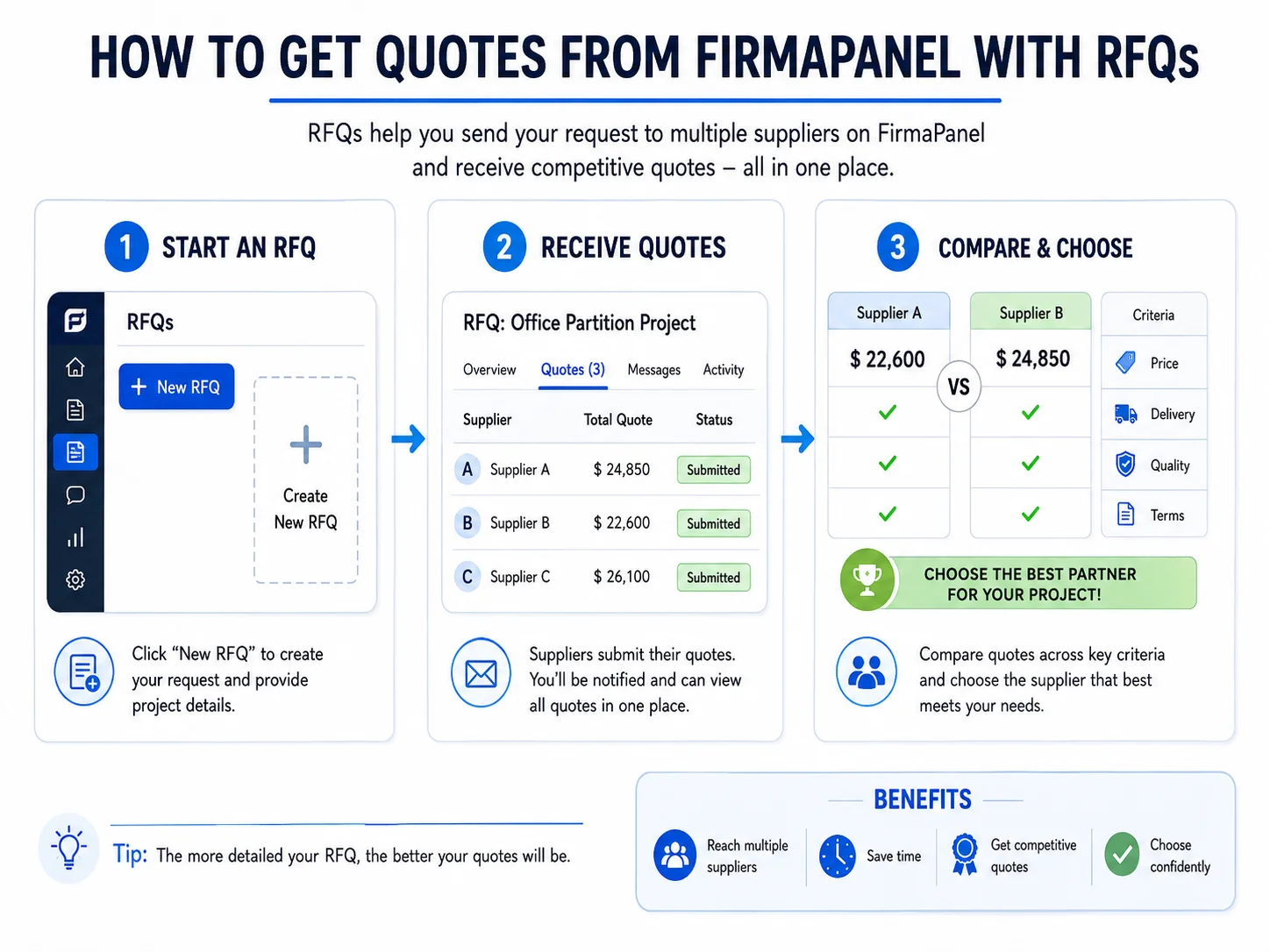
An online request for quotation, usually called an RFQ, tells suppliers exactly what you want to buy and asks them to return a commercial offer. A useful quotation should identify the product, quantity, price basis, delivery term, lead time, payment conditions and validity period.
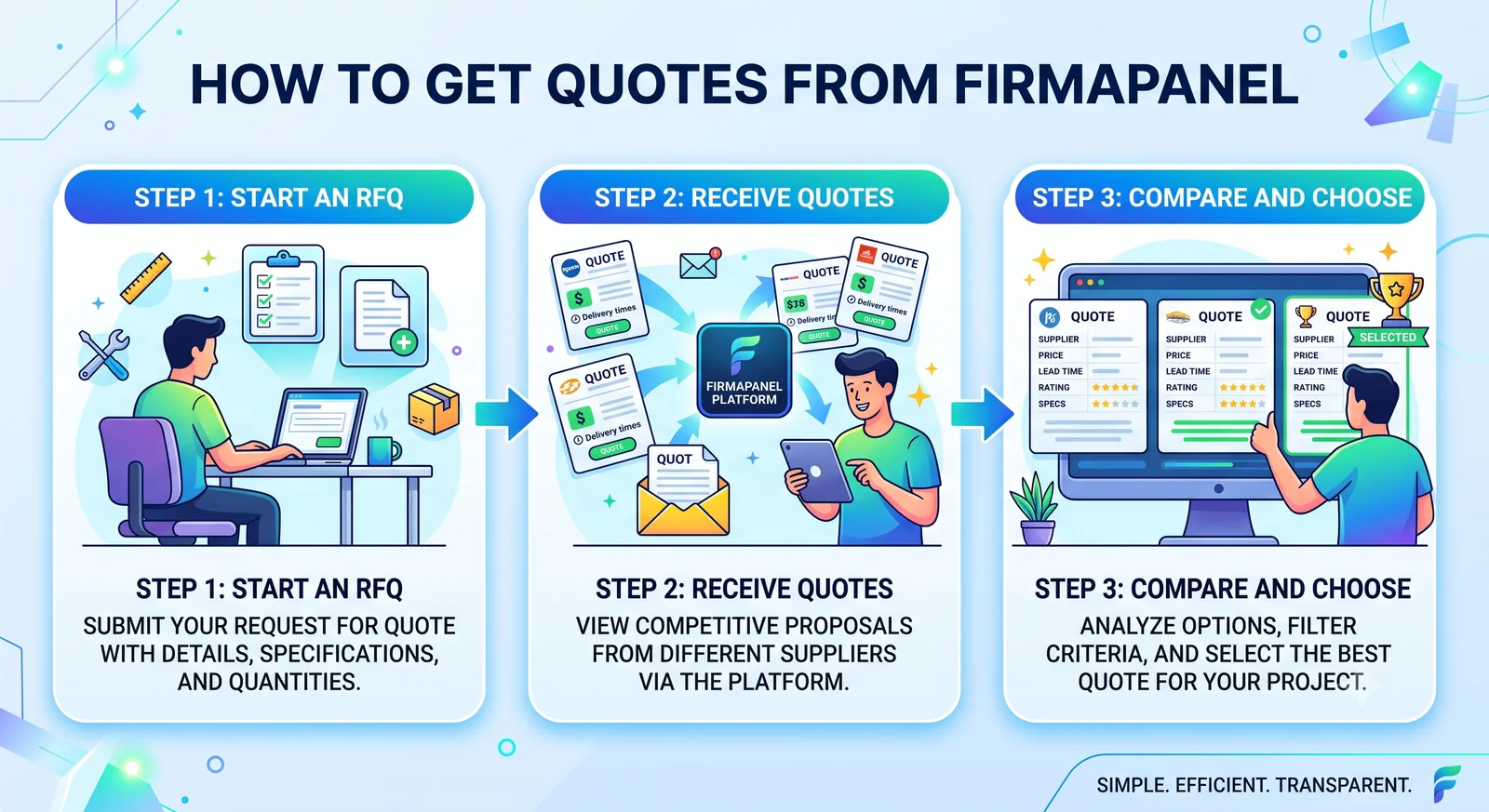
The process normally follows five steps:
- You describe the product and purchasing requirement.
- Relevant manufacturers, exporters or wholesalers review the request.
- Suppliers send quotations or ask technical questions.
- You place the offers on the same commercial basis.
- You verify the shortlisted supplier before paying or ordering.
The quality of the replies depends heavily on the quality of the request. A detailed RFQ does not need to be long, but it must remove the assumptions that affect price.
Start with a specification suppliers can price
 Before contacting suppliers, write down the minimum acceptable product. Use measurable details wherever possible.
- Product: exact name, model or intended application
- Quantity: pieces, kilograms, tonnes, sets or containers
- Material: grade, composition, coating or finish
- Dimensions: size, thickness, tolerance or capacity
- Standards: DIN, ISO, EN, ASTM, food-contact or sector-specific requirements
- Packaging: bulk, retail, pallet, carton or private-label packaging
- Destination: city, port and country
- Required date: when the goods should be ready or delivered
For a standard catalogue product, a manufacturer’s model number or reference image may be enough. For a custom component, attach a drawing and state which dimensions are critical. Mark units clearly. A supplier should never have to guess whether “10” means millimetres, centimetres or inches.
A weak RFQ and a usable RFQ
Weak request:
We need industrial fasteners. Send price.
Usable request:
We require 12 tonnes of hex bolts, nuts and flat washers for machinery assembly. Please quote carbon steel grade 8.8 with zinc plating and stainless steel A2 alternatives. Products must comply with the listed DIN standards in the attached sheet. Pack each size separately in export cartons. Quote DAP Tallinn, Estonia, and state production lead time, sample availability, payment terms and quotation validity.
The second request gives suppliers enough information to calculate material, production, packing and delivery costs. It also asks every supplier to answer the same commercial questions.
Tell suppliers how to quote delivery
A unit price has little meaning unless you know where the supplier’s responsibility ends. Ask for a named Incoterm and location, such as EXW supplier factory, FOB Shanghai, CIF Jebel Ali Port or DAP your warehouse.
Do not compare an EXW quote directly with a CIF or DAP quote. An EXW price may exclude export handling, inland transport, customs formalities and international freight. A higher-looking delivered offer can be cheaper after these costs are added.
When you are uncertain which option is best, ask the supplier to show two price bases. For example:
- EXW factory price
- FOB price at the named port
- Optional CIF price to your destination port
This makes the product cost and logistics cost easier to separate.
Ask for the details that change the final cost
The unit price is only one line in a purchase. Ask suppliers to disclose the following before you shortlist an offer:
- Minimum order quantity
- Sample price and sample freight
- Mould, tooling, plate or setup charges
- Custom printing and packaging costs
- Number of units per carton or pallet
- Gross weight and shipment volume
- Production lead time
- Warranty and spare-parts conditions
- Payment terms and required deposit
- Quotation validity
Packaging information is especially important for lightweight or bulky goods. Two suppliers may offer the same unit price, but poor carton efficiency can increase freight and warehouse costs.
Make supplier quotations comparable
Create a simple comparison sheet. Do not copy only the headline price. Record each offer as it was quoted, then calculate a common basis.
| Comparison point Supplier A Supplier B Supplier C | |||
| Specification confirmed | Yes | Alternative material | Not stated |
| Order quantity | 10,000 units | 10,000 units | 12,000-unit MOQ |
| Price basis | FOB | CIF | EXW |
| Production time | 25 days | 40 days | 20 days |
| Tooling charge | Included | USD 450 | Not required |
| Payment | 30% deposit | 50% deposit | 100% before dispatch |
Where possible, calculate the estimated landed cost per saleable unit:
Landed cost = product value + tooling + inspection + inland transport + international freight + insurance + import charges + local delivery
The calculation does not have to be perfect at the first stage. Its purpose is to prevent a cheap EXW price from winning against a more complete offer without proper comparison.
Read exclusions and assumptions carefully
 A professional quotation should state what is included. It may also list exclusions. Check for phrases such as “subject to final drawing,” “packing not included,” “freight estimate only,” “taxes excluded” or “price based on full-container quantity.”
Also check whether the supplier has silently changed your requirement. Common examples include:
- A different material grade
- A thinner wall or lower capacity
- Generic packaging instead of private label
- A larger MOQ than requested
- A substitute certification
- A different delivery term
An alternative can be useful, but it should be labelled as an alternative rather than presented as a direct match.
Do not select a supplier from the quotation alone
A quotation shows what a company is offering. It does not prove that the supplier can consistently manufacture or deliver it.
Before placing a meaningful order, verify the business and the proposed product. Depending on the order, this may include:
- Checking the company’s legal name and business details
- Reviewing its product range and manufacturing capability
- Requesting relevant certificates and test reports
- Ordering a sample or approving a pre-production sample
- Using a factory audit or third-party inspection
- Confirming bank details through a known contact channel
- Starting with a manageable trial order
Be cautious when a supplier refuses to answer basic specification questions, pressures you to pay immediately, changes bank details unexpectedly, or offers a price far below every comparable quotation without a technical explanation.
Questions to send after receiving a quote
You do not need to accept or reject an offer immediately. A short clarification round often reveals which suppliers understand the requirement.
- Can you confirm that every item matches the attached specification?
- Which costs are not included in your price?
- Is the quoted lead time measured from deposit, drawing approval or sample approval?
- What is the packed weight and shipment volume?
- Can you provide a sample from the same material and production process?
- Which documents will be supplied with the shipment?
- How long is the quotation valid?
- What happens if inspection finds a specification mismatch?
Send the same important questions to every shortlisted supplier. This keeps the comparison fair and creates a written record of the agreed basis.
A reusable online RFQ template
Product: [exact product name]
Application: [how or where it will be used]
Specification: [material, size, standard, model and required features]
Quantity: [number and unit]
Packaging: [bulk, retail, private label or export packing]
Destination: [city/port and country]
Delivery basis: [requested Incoterm and named place]
Required date: [goods-ready or delivery date]
Please include: unit price, MOQ, sample terms, tooling charges, lead time, payment terms, shipment dimensions, certification details and quotation validity.
Adapt the template to the product. A machinery RFQ may need power supply, capacity, installation and spare parts. A food RFQ may require ingredients, shelf life, labelling, certificates and storage conditions. A custom manufactured part may need drawings, tolerances and inspection criteria.
Request quotes from suppliers through FirmaPanel
FirmaPanel helps buyers publish a purchasing requirement and receive responses from relevant suppliers. Instead of sending incomplete enquiries one company at a time, prepare a single structured request that suppliers can evaluate on the same basis.
Before submitting, check that your RFQ contains the product specification, quantity, destination, delivery expectation and any document or packaging requirements that affect price.
Post RFQ and start comparing supplier offers for your next purchase.