
MOQ
—
Category
Cutlery
Product details
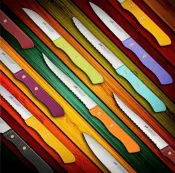
Ideal Knife Collection
Born in the XIX century the « Idéal » shape, which has been the most popular knife shape among European Chefs. Its fully forged triangular blade shape and rounded bolster make it well balanced for a perfect dynamic of cut while its full guard and beak’s butt provide security and comfort when cutting.
Idéal uses a 4116N Steel : a professional cutlery grade stainless steel featuring 0,5% of Carbon, 15 % of Chromium as well as Vanadium and Molybdenum enriched with Nitrogen to provide additional mechanical strength.
A wide collection ofeatures on eof the largest offer covering all cooking enthusiats and professional needs : 28 models, starting from the 6cm beak paring knife, up to a 30cm Salmon and Ham knive, and even 35cm Chef knife.
The Ideal range is traditionnaly feature with a black POM handle, hand polished, featuring brasss or stainless steel rivets also available with several different handle materials:
- TOQUE BLANCHE: white handle,
- PROVENÇAO: olive wood handle,
- SAVEUR: pakka wood handle,
- PERIGORD: walnut handle
The blade bevel V shape 25° cutting edge is manually sharpened to provide you a perfect cut every time. We recommend that blade edge to be sharpened at least on a weekly basis to keep a perfect edge.
We recommend to hand wash the knife immediately dry it with a soft cloth.
Each knife is fully made in French Capital of Cutlery : Thiers, France.
Source with clarity
Interested in this product?
Ask Rousselon Dumas Sabatier SAS about pricing, availability, customization, and delivery requirements in one private inquiry.
- Private buyer–supplier conversation
- Free buyer account
- Keep messages and quotes organized
From this supplier
View vendor profile
More from Rousselon Dumas Sabatier SAS
Explore more approved listings published by the same company.


Compare the market
Browse category
Related products
Review similar products from other suppliers in this category.

Sourcing intelligence
Practical guides for global trade
Recent FirmaPanel articles for evaluating suppliers, sourcing products, and preparing export conversations.
 Trade guide
Should You Ask for Samples Before Placing a Bulk Order?
Learn when to request product samples before placing a bulk order, what samples can and cannot prove, and how buyers should use sampling to reduce sourcing risk.
Read article
Trade guide
Should You Ask for Samples Before Placing a Bulk Order?
Learn when to request product samples before placing a bulk order, what samples can and cannot prove, and how buyers should use sampling to reduce sourcing risk.
Read article
 Trade guide
How Much Should You Really Order From a New Supplier?
Learn how to size a first order from a new supplier using MOQ, demand, lead time, freight, quality risk and cash exposure instead of unit price alone.
Read article
Trade guide
How Much Should You Really Order From a New Supplier?
Learn how to size a first order from a new supplier using MOQ, demand, lead time, freight, quality risk and cash exposure instead of unit price alone.
Read article
 Trade guide
Should You Use DDP When Importing from China?
Learn when DDP shipping from China can simplify importing, where customs and tax risks appear, and when DAP or FCA may be a safer choice.
Read article
Trade guide
Should You Use DDP When Importing from China?
Learn when DDP shipping from China can simplify importing, where customs and tax risks appear, and when DAP or FCA may be a safer choice.
Read article