MOQ
—
Category
Cutlery
Product details
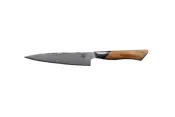
A-30 Santoku Knife 18cm
Art nr: 0902
Knife Type: Santoku knife
Place of Origin: Sweden, Japan
Brand Name: Ryda knives
Model name: A-30 Santoku knife
Blade material: 3 layers high carbon damascus steel (316/316l & Aus-10 powder steel)
Handle material: Stabilized figured walnut
Grind angle: 2x15%
Hardness: 60 HRC
Length: 32cm
Blade length: 7 inch /18cm
Handle length: 13,5cm
Blade width: 4,7cm
Thickness: 2 mm
Weight: 175g
"In the A-30 serie I have gone back to the roots of being a chef. When you work in kitchens you most likely hold your knife more on the blades then the handles.
This serie have been designed to be comfortable to chop for hours. The balance is also higher up on the blade compare to our other knives.
It have a very soft bolster and hard polished on the end of the blade next to the handle so you will not have pain in you finger after
you have worked with the knife for many hours."
This handle on our A-30 serie is pretty slim 2,4x2,2cm on its thickets spot on the handle.
And is more ment to hold on the blade. So if you are use to hold your hands just on the handle this knife might not be to you.
Its more a Japanese style of knife.
The core of the blade is a Aus-10 steel and has a hardness of 60HRC. The other bearings are made of stainless steel 316/316l and together they have been vacuum-treated. This means that the sharpness lasts a long time with easier knife care.
The walnut handle has gone through a vacuum and clue infuse treatment, so its very hard.
Source with clarity
Interested in this product?
Ask Ryda Knives AB about pricing, availability, customization, and delivery requirements in one private inquiry.
- Private buyer–supplier conversation
- Free buyer account
- Keep messages and quotes organized
From this supplier
View vendor profile
More from Ryda Knives AB
Explore more approved listings published by the same company.
Compare the market
Browse category
Related products
Review similar products from other suppliers in this category.
More products in this category
Sourcing intelligence
Practical guides for global trade
Recent FirmaPanel articles for evaluating suppliers, sourcing products, and preparing export conversations.
 Trade guide
You Paid for the Mold. Why Can't You Take It to Another Factory?
Paid for a custom mold? Learn who owns manufacturing tooling, what to put in supplier contracts, and how to transfer molds between factories.
Read article
 Trade guide
The Factory You Approved May Not Be Making Your Order
Your approved factory may not make your order. Learn how to identify unauthorized subcontracting, verify production sites, and control sourcing risks.
Read article
 Trade guide
The Fastest Supplier Quote May Be the Worst Deal: How to Verify Production Lead Times
Is the fastest supplier always the best? Learn how to verify manufacturing lead times, factory capacity, material readiness and reliable shipment dates.
Read article